
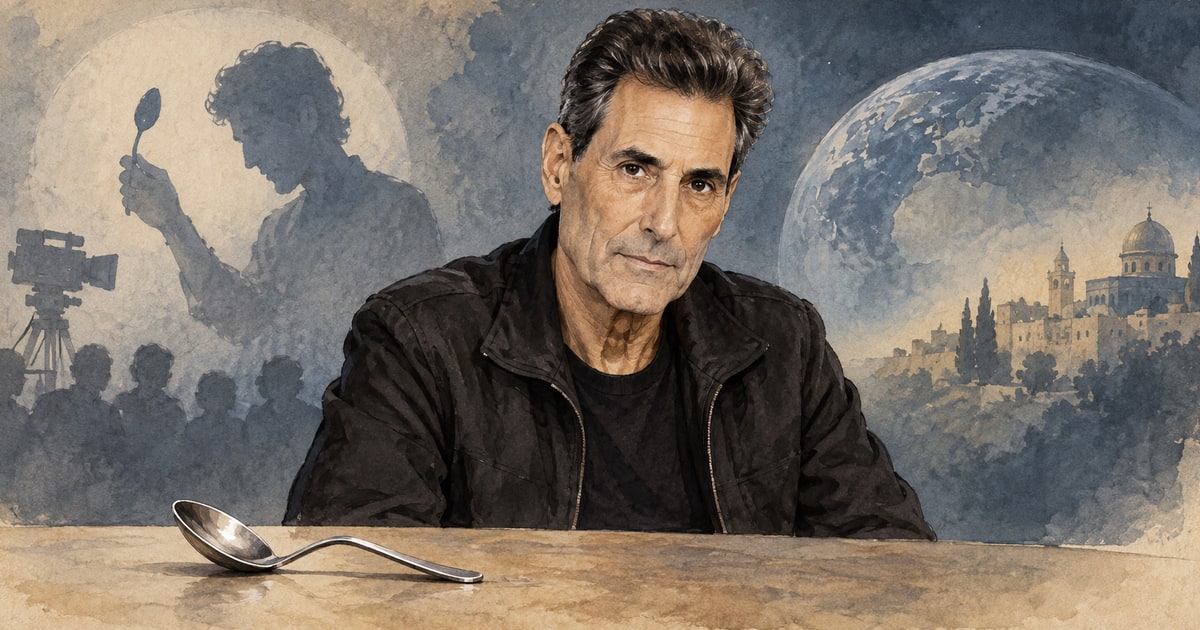
Cover: AI-generated editorial illustration, not an archival photograph or a record of an experiment.
Quick Guide
Uri Geller is an entertainer and self-described psychic known internationally since the 1970s. His demonstrations prompted research and criticism. A broadcast, journal publication, or declassified file documents a claim or event; none is automatically proof of paranormal ability.
On this page
Uri Geller is an Israeli-born entertainer and self-described psychic. He is known for spoon bending, thought reading, and other abilities that were seen as unusual mental feats. He became an international public figure in the 1970s and is a name that comes up when talking about the paranormal.
His career raises questions that believers and skeptics both wonder about: What does an impressive demonstration actually establish? Geller’s demonstrations have inspired scientific investigation, criticism, excitement, and disagreements. Understanding that history requires separate facts about what he claimed, what observers reported, and what a particular test could show.
You don’t have to put down spiritual curiosity to evaluate the evidence. You also don’t have to accept that every statement associated with the famous psychic is true in order to be interested in psychic possibilities. Geller’s story is informative when the events are kept in the right context.
Performers and Celebrities
Geller was born in 1946 in Tel Aviv, when the city was in Mandatory Palestine. His early life and then his public identity became part of a big story about a person who said he had unusual abilities and gifts. Stories of his childhood experiences belong to his own personal narrative and should be distinguished from independently documented events.
He developed a career performing for audiences before he was widely known. In the 1970s, he appeared in Britain and the United States, which led to his demonstrations having larger audiences. Television helped make a bent spoon a recognizable image of psychic powers.
How simple the object was mattered. A spoon, a drawing, or a watch was familiar enough that the viewers could imagine being able to try testing these claims at their own home. This didn’t require a technical explanation before it attracted attention.
Over the following years, Geller’s public work included interviews, books, entertainment appearances, and projects that were all built around his own reputation. The Uri Geller Museum in Jaffa later became another place for presenting objects and stories from his career. These things were documented and created a cultural presence. This doesn’t validate paranormal abilities.
Geller’s Claims
Geller is often associated with psychokinesis, the claimed ability to affect physical objects through mental means. His spoon-bending demonstrations are usually talked about in this category. He has also presented feats associated with telepathy, or the claimed transmission of information without ordinary sensory access.
These claims need to be looked at differently because bending metal is different from reproducing a drawing that’s never been seen. A result that’s relevant to one thing doesn’t automatically mean that the other is true.
How things are described also matters. A spoon that’s bent during a demonstration is an observation, but the spoon bent because of psychic energy is an explanation. The observation on its own doesn’t determine the mechanism, especially if the conditions don’t exclude ordinary manipulation.
At the same time, a drawing that appears similar to a target can be interesting without figuring out how the similarity occurred. Evaluation depends on the targets available, the scoring method, the information that’s accessible to the participants, and whether any unsuccessful attempts are included.
Why Laboratory Work is Important
In the 1970s, Russell Targ and Harold Puthoff investigated paranormal claims at the Stanford Research Institute, which is now known as SRI International. The institute shouldn’t just be described as Stanford University, but the institutional identity matters when summarizing the history behind it.
The work that they did included experiments involving Geller and other participants. A 1974 paper, Information transmission under conditions of sensory shielding, appeared in Nature. The authors interpreted their results as suggesting information acquisition outside known sensory channels.
Publication in a prominent journal made the research even more visible. As our article on Tesla and psychic claims illustrates, a public reputation and a specific scientific finding are different things. Publication means a report was put into a scientific record, but it doesn’t mean that every claim in the report is a scientific fact. The difference is important to understand the controversy.
It is misleading to treat the entire paper as a test of Geller’s spoon bending. The research looked at different experiments and participants. Readers need to identify which results concern which person and which abilities are seen before drawing any conclusion.
Journals and Caution
Nature published the editorial Investigating the paranormal, alongside the paper. It discussed serious reservations about the work, including whether the conditions sufficiently excluded ordinary information transfer and whether the material amounted to preliminary studies rather than a completed experimental demonstration.
This is important in history because it prevents a common simplification that Nature proved Geller was psychic. The journal’s own presentation was more cautious than that slogan suggests.
The interpretation of the article and the concern should both be seen. Reporting only the favorable conclusion leaves out the study’s limitations. Reporting only that critics objected leaves out why the findings attracted interest in the first place.
Readers today find that a useful task isn’t about picking the more exciting things. It’s about asking whether the design and the results support the specific conclusions being offered, and what kind of work is needed to make the conclusion reliable.
Three Questions for Evaluating a Famous Test
Identify the exact task: bending an object, matching a drawing, or obtaining hidden information.
Check target selection, access to information, judging methods, and whether all attempts were recorded.
State only what the result supports. Look for independent replication before generalizing.
What Sensory Shielding Does and Does Not Prove
Sensory shielding is used to try to keep someone from getting information about a target through normal ways. Depending on the type of experiment, this might mean keeping people in separate rooms, hiding the target, or using other methods to prevent someone from seeing or hearing information they should not have.
Even though the term “sensory shielding” sounds like it completely prevents someone from getting information, it really depends on how the experiment was set up. Researchers still have to consider whether there were other ways the person could have received clues. For example, could someone involved in the experiment have accidentally given something away? There also needs to be enough information about the experiment for other researchers to understand exactly what happened and decide whether the controls were strong enough.
For example, imagine a drawing experiment where someone draws a circle, and the hidden target is a picture of the sun. At first, the similarity might seem pretty impressive. However, it becomes harder to judge if many of the possible targets were round objects. The results could also be affected if the people comparing the drawings already knew which picture they were supposed to match.
A stronger experiment decides on the rules before the testing begins and keeps important information hidden from the people who are judging the results. It should also include all of the attempts instead of showing only the ones that seem successful. This is why the details of how an experiment was performed are more useful when looking at the evidence than only seeing a few impressive examples.
The Johnny Carson Appearance
Geller was on The Tonight Show in 1973. This is a famous segment because it didn’t produce a convincing demonstration that was expected of him under the conditions of the program. Magician James Randi talked about it later and how the show’s team were cautious about the objects being used.
The episode became a central example in skeptical accounts of Geller’s career. PBS’s material for An Honest Liar, a documentary about James Randi, places their dispute within Randi’s broader work investigating paranormal claims.
Just because someone appears on television doesn’t mean it’s a scientific research program. This involves an audience, time pressures, performance expectations, and conditions that are different from those in a laboratory. A failure to demonstrate a claimed effect under the program’s conditions is relevant, but its implications should be stated narrowly.
A conclusion on this would be limited to saying that the appearance didn’t give a successful demonstration of what was claimed in the setting. It doesn’t mean that every possible question about psychic phenomena is fake, and it doesn’t mean that the story should be erased just because it can be uncomfortable for someone who does believe in it.
What Magicians Contribute to Testing
Magicians study how expectations, attention, preparation, and presentation create effects that look impossible. Their level of expertise can be helpful when an experiment needs a skilled performer or an object that might need to be manipulated.
Showing that an effect can be reproduced by ordinary means shows an alternative explanation. It doesn’t automatically prove the exact method that’s used in every performance. The additional claims require evidence about the performance in question.
Knowing the difference allows for a fair discussion. A critic can show that a bent spoon isn’t evidence of psychokinesis without saying that every detail of Geller’s actions is right or wrong. A supporter can agree with the point without having to settle their own beliefs about the paranormal.
When something is being scientifically tested, it is important to have good controls in place. The test should be set up so that normal explanations or simple tricks cannot easily cause the same result. This is more reliable than depending on someone to say that they were watching closely and would have noticed if a trick was being used.
Looking at Government Files
Geller appears in declassified material about government interest in paranormal research, including an SRI report retained in the CIA reading room. A document in an intelligence archive might sound interesting, especially if the headline suggests that the agency confirmed supernatural powers.
Archives can have reports, correspondence, proposals, press clippings, and disputed interpretations. The existence of these archives and materials means that they were collected or retained. This doesn’t mean that the agency verified them.
When reading a document, look at the author, purpose, and the kind of record. A researcher’s favorable summary, a press clipping, and an internal assessment are different kinds of evidence. A release date might be decades later than the event it shows.
This is useful to know because official storage isn’t the same as official endorsement. Being curious isn’t the same as being successful.
How a Memorable Result Can Become a Larger Story
Imagine watching someone on television who has one really impressive result. Even if they have been on television for years, that one experience might be what you remember the most. As time goes on, it can be easy to start thinking that the person was successful all the time, even if you never actually saw every attempt they made.
The opposite can happen too. Someone might remember seeing one demonstration that did not work and then assume that everything else the person has ever done must have an explanation too. In both situations, one experience can start to shape how someone thinks about a much bigger picture.
A good way to avoid this is to keep what you believe happened close to what you actually saw. If one demonstration seems successful, then that is one example worth looking into. If one demonstration fails, then it is one failure to consider. Saying that someone has an ability that works consistently would require looking at many more examples under conditions where the results can be carefully evaluated.
You can use the same idea when thinking about a psychic reading that feels meaningful to you. Write down exactly what the reader said, what information you had already given them, and what actually happened afterward. Keeping these things separate can help you look at the reading more clearly without taking away from how meaningful the experience might have been to you.
What Would Count as Stronger Evidence
Stronger evidence would start with a clear claim that can actually be tested. The conditions and expected result should be decided before anyone knows what is going to happen. The expected result should also be specific enough that if it does not happen, the result cannot simply be changed or explained afterward to make it seem successful.
It is also important to see if other people can get similar results. If something only works during one particular test or with one group of people, there could be something about that situation affecting the outcome. Other researchers should be able to repeat the same process and look at the results without having to depend only on what the original group believed happened.
Looking at all of the results matters too. If there were many attempts, you need to know about the ones that did not work or were unclear, along with the ones that seemed successful. Seeing only the most impressive examples does not give the same picture as seeing the complete results.
Looking carefully at unusual claims does not mean that you have to make fun of them or immediately decide that they cannot be true. Testing them fairly gives the claim a chance to show whether the results can happen consistently. It also gives people better information to use when deciding what they personally believe about the experience.
Looking at Specific Events
When looking at a new account of Geller demonstrations, identify the kind of materials you’re looking at. A short entertainment clip, a participant’s recollection, a research paper, and an editorial are all different. Each has information, but they answer different questions.
- What was the stated task, and who chose the objects or targets?
- What happened next?
- Which details appear in the record, and which were added later?
These questions help avoid confusion between chronology and validation. Similar source-checking problems appear in our Nostradamus prediction fact-check. A document found later might talk about an earlier event in a persuasive way, but the document’s production date might not make the original evidence new. Also, a newly released article or archive can have an old claim instead of a new experiment.
Write down a conclusion that supports the material. You might be able to say that an audience reacted with surprise and that the researcher reported a certain result. Keep the conclusion separate so that public history can be understood without demanding that every source can be proven.
Final Thoughts: Uri Geller
Uri Geller helped bring paranormal claims into mainstream television conversation. His name was linked with visual acts that were recognizable, and the reactions to his work raised different questions about evidence versus performance in the public’s eye.
Geller’s story shows how different roles can get mixed together, such as a spiritual figure, a research participant, an author, an entertainer, and even a celebrity. Success in one role does not establish the claims associated with another.
For people who believe in psychic abilities, this difference can be important. Your spiritual outlook doesn’t have to depend on a public personality. You can look at a famous case, appreciate the culture behind it, and still be uncertain about some of the claims.
The best-grounded account of Uri Geller shows the impact and the unresolved, unproven part of his paranormal claims. His career is worth understanding, though, because it shows persuasion, wonder, testing, and public memory. Curiosity is more useful when it’s paired with helpful questions.
Key Takeaways
- Separate Geller’s documented public career from his claims about how effects occur.
- The 1974 Nature paper and the accompanying editorial need to be read together.
- A demonstration reproduced by ordinary means supplies an alternative explanation, not automatic proof of a particular method in every case.
- An intelligence archive preserves material; storage and release do not by themselves validate the contents.
Frequently Asked Questions
1. Who is Uri Geller?
Uri Geller is an Israeli-born entertainer and self-described psychic, internationally known for spoon-bending and other claimed paranormal demonstrations.
2. When and where was he born?
He was born in 1946 in Tel Aviv, then in Mandatory Palestine.
3. When did he become internationally famous?
His appearances in Britain and the United States brought him wide international attention during the 1970s.
4. What is spoon bending supposed to demonstrate?
Geller’s spoon-bending performances are associated with claims of psychokinesis. A bent object alone does not establish that mental influence caused the change.
5. What is telepathy?
Telepathy refers to a claimed transfer of information without ordinary sensory communication. The label is a claim about a mechanism, not proof of it.
6. Who studied Geller at SRI?
Russell Targ and Harold Puthoff investigated paranormal claims involving Geller and other participants at the Stanford Research Institute.
7. Was SRI the same as Stanford University?
The research discussed here took place at the Stanford Research Institute, now SRI International. It should not be described simply as a Stanford University experiment.
8. What appeared in Nature in 1974?
Targ and Puthoff published Information transmission under conditions of sensory shielding, reporting experiments they interpreted as suggesting information acquisition beyond known sensory channels.
9. Did publication prove the paranormal explanation?
No. Publication puts a report into the scientific record; the controls, interpretation, and reproducibility still need evaluation.
10. Was that paper solely about spoon bending?
No. It addressed different experiments and participants. Its findings should not be described as blanket validation of Geller’s spoon-bending claims.
11. Why mention Nature’s editorial?
The accompanying editorial discussed reservations about the research. Including it prevents the paper’s publication from being mistaken for unqualified journal endorsement.
12. Why is the Carson appearance discussed?
The 1973 Tonight Show appearance did not produce the expected convincing demonstration in that setting. It became prominent in skeptical accounts, but it was not a full scientific research program.
13. Does reproducing an effect reveal how every performance was done?
No. It demonstrates that an ordinary explanation is possible; identifying the method in a particular performance requires evidence about that event.
14. Do declassified documents certify psychic powers?
No. Archives may contain research reports, correspondence, and disputed interpretations. A document’s author, purpose, methods, and conclusions must be assessed individually.
15. What would stronger evidence require?
A specific testable claim, advance rules, controls against ordinary information transfer or manipulation, complete reporting, and independent replication would strengthen the case.